 |
 |
 |
 |
 |
 |
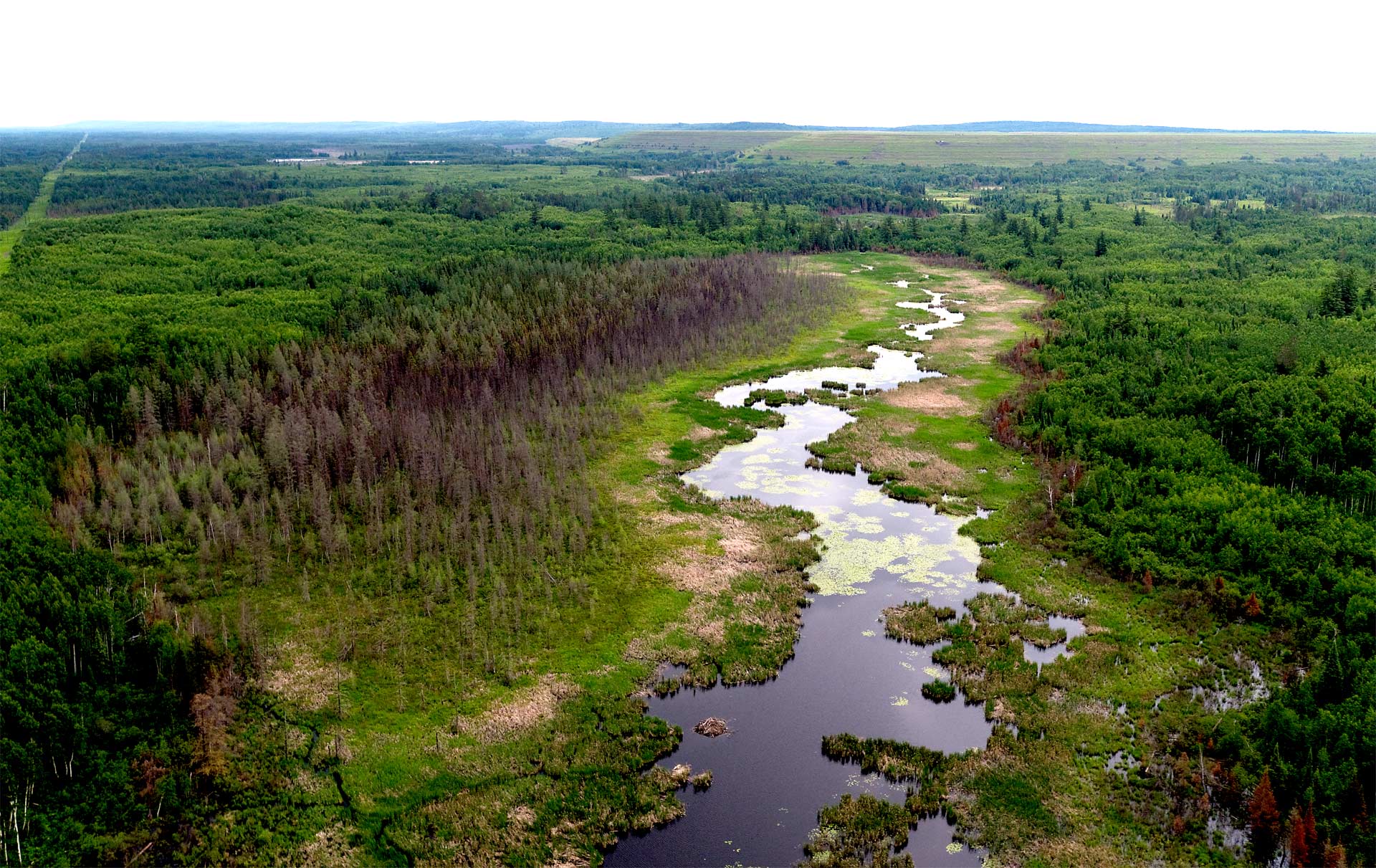
Story and drone photos by Rob Levine | August 4, 2026
Can a huge pond lined with kitty litter prevent a slurry of toxic mining waste from polluting nearby lakes and rivers? In a nutshell, that is the question that the Minnesota Department of Natural Resources (DNR) ought to answer - and it's an easy answer - as it evaluates a long stalled proposal to mine copper and nickel near the northeast Minnesota city of Babbitt.
Unfortunately, the DNR has been more than willing to evade this crucial question. Instead, it has waded into the arcane, often baffling thicket of administrative procedure law.
In so doing, the agency, which is charged with protecting Minnesota's natural resources, has effectively thrown a life ring to the proposed NorthMet copper nickel mine.
Hopefully, that will not be enough to revive the project. Because while Republicans in Washington have done everything in their power to grease the skids for another controversial proposed copper nickel mine - the Twin Metals project near the Boundary Waters Canoe Area Wilderness - the proverbial wheels have come off NorthMet.
Over the past months the project's Engineering firm of Record split with new owner NewRange, and the outside counsel for the Minnesota DNR, which had been defending its most important permit in court, has abruptly withdrawn.

Since it was first proposed in 2005, the NorthMet project has moved at a glacial pace. It didn't earn a satisfactory Environmental Impact Statement until 2015, and wasn't awarded the state's Permit to Mine until 2018. Since then, legal challenges brought by environmental groups WaterLegacy and the Minnesota Center for Environmental Advocacy (MCEA) and the Fond du Lac Band of Lake Superior Chippewa (the Band) have been largely successful, with the project's most important permits either reversed or revoked.
This is not due to regulatory overreach or delay; it is a product of shoddy geological, engineering and legal work.
NorthMet's low grade ore is 99.7% waste
For those not familiar, NorthMet's plan is an attempt to mine low-grade ore on the cheap, using facilities from a long defunct taconite plant. That the project hasn't been scrapped is a testament to an alarming reality: despite potentially catastrophic outcomes, the state's waters are vulnerable to political expedience
In the beginning, NorthMet, then known as PolyMet, was partially owned by Glencore, the Swiss mining giant notorious for global lawbreaking. Today PolyMet has evolved into a new entity called NewRange, which is owned in a 50/50 partnership between Glencore and Teck Resources, a Canadian mining conglomerate. Despite the new ownership structure, courts still refer to the project as PolyMet or NorthMet.
The NorthMet plan should have been laid to rest in November, 2023 - two and a half years ago - when Administrative Law Judge (ALJ) James E. LaFave issued a compelling and devastating decision. In a 40 page ruling, LaFave concluded that the plan for disposing of the mine waste - actually 99.7% of what is extracted from the earth - did not meet the state's environmental rules.
The ALJ's decision came in the wake of an earlier decision from the Minnesota Supreme Court. In that case, the court concluded that NorthMet Permit to Mine, which was issued by the DNR, violated state law for a number of reasons, including that it did not specify a time period for the mine's reclamation after closure. Neither of these fundamental problems have been resolved in the five years since the Supreme Court ruling.
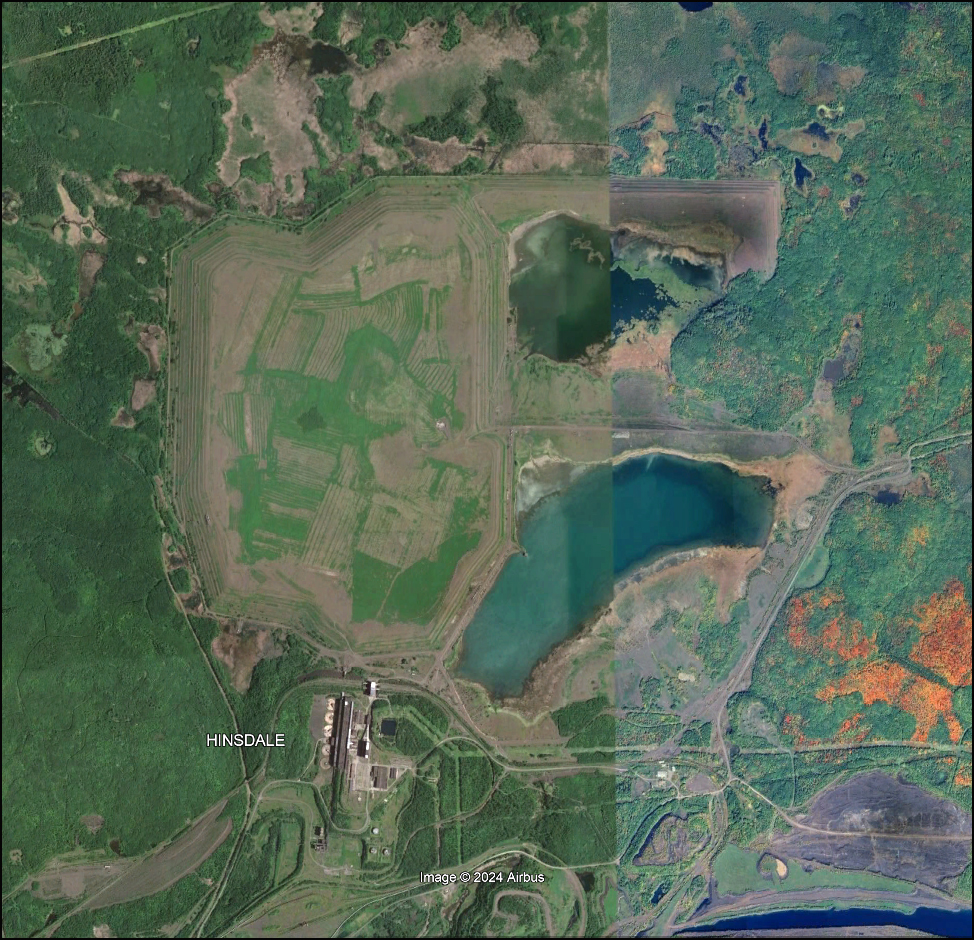
Google Earth image of the PolyMet Flotation Tailings Basin (FTB) (2023 image)
The Minnesota Supreme Court ruled against NorthMet five years ago
As part of its 2021 decision, the Supreme Court ordered the DNR to conduct a so-called contested case hearing. The goal: to determine whether PolyMet's plan for disposing of its waste tailings satisfies the state's Reactive Mine Waste Rule. Under the law, mine owners are required to show that, after a mine is closed, the reactive tailings will be shielded from interacting with water. That is to prevent the inevitable byproduct of such a mixture - an acid soup filled with heavy metals and neurotoxins - from polluting public waters.
PolyMet's plan would make Rube Goldberg proud. The company wants to dump its waste into an old iron mining tailings pond, then deposit a concoction consisting largely of bentonite, the active ingredient in cat litter, from a pontoon into the pond. Theoretically, this would prevent the foul slurry from leaking into the watershed.
Yet, somehow, this did not produce skepticism at the DNR, which seemed to have swallowed PolyMet's solution hook line and sinker. But at the contested case hearing, Tom Radue, PolyMet's witness from Barr Engineering, confirmed that at least 300 million gallons of water would traverse the tailings each year and need to be collected from beneath the basin, then pumped back into the top. According to the DNR, this would have to be done for centuries, and possibly for as long as 900 years.
Given those facts in November 2023 Administrative Law Judge LaFave ruled against this frankly quackish reclamation plan. That should have been the end of the NorthMet project. But under Minnesota's administrative law, such findings are mere recommendations and the agency is free to respond in different ways.
Part of that post-decision process allows the parties to relitigate what the decision means, and how it should be addressed. In this case, Sarah Strommen, the commissioner of the DNR, and her counsel were participants, and so they could not rule on the administrative law judge's decision. Instead, Strommen appointed Grant Wilson, one of her regional directors, as the "decider" in the case. The people at the agency who were in charge of the actual permit formed a new Hearing Team to defend the permit.
State law gives the agency calling the contested case hearing three options after a decision: It can affirm, deny or amend the ruling. A month after the ALJ decision, in December 2023, Grant Wilson informed the parties that the so-called "closing of the record" - after which a decision must be made - would be June 7, 2024.
But then NewRange introduced a new wrinkle. In February 2024, the company informed the Fond du Lac Band of Lake Superior Chippewa that it was reconsidering the tailings basin plan. The Band is one of the legally aggrieved parties because it is downstream of the proposed mine, and its Reservation waters could be polluted by the NorthMet project.
That communication, along with a story in the Duluth News Tribune, set up the arguments over the contested case hearing over the next two and a half years. On the one hand, the litigants are still arguing about the meaning and propriety of the administrative law judge's ruling. On the other hand, they are arguing about what NewRange's assertions that it is doing new studies will mean for the case.
Shortly after receiving the communication from NewRange, the Band shared with Wilson their view: the Permit to Mine should be invalidated because the company seemed to be abandoning its plan for the tailings basin [formally called the Flotation Tailings Basin (FTB)], a critical element of the entire enterprise. As such, the Band said, the permit - and the hearing - was rendered moot. NewRange objected to that characterization and encouraged Wilson to soldier on with the post-decision process.
This set up a sort of Schrodinger's tailings basin. Was the FTB plan abandoned by NewRange's stated plans for new studies? Or was it still in play? To this day NewRange hasn't made a commitment, insisting it is weighing options, but still clinging to an assertion that it may still use the original tailings basin.
This instigated a whole new set of questions around just what is the formal legal status of the Permit to Mine? Was it merely remanded to the DNR by the Minnesota Supreme Court, in which case the DNR would then be free to amend it, or did the high court also reverse it, which is what the high court actually said in its opinion, in which case the permit cannot be amended or transferred to new owners because it is no longer in existence?
One might reasonably ask, what do theoretical studies have to do with an Administrative Law Judge's finding that spreading cat litter over toxic sulfide tailings would not sufficiently reduce the risk of catastrophic pollution?
State law says that the agency calling the hearing has three choices: affirm, deny, or amend the ALJ's opinion. It doesn't say that the decider can change the facts, but a decision-maker can decide that the case before him is moot. Otherwise, his job is to rule on the opinion. This is important because as the process unfolded Wilson eventually ruled to indefinitely stay the ALJ's decision based on an August, 2024 NewRange press release.
At first Wilson had declined to rule on what these alleged studies from NewRange meant to the case, saying new evidence could not be admitted. So he chose to discount NewRange's communication to the Band, and in May 2024 told the parties to ignore the new factors and get on with their arguments over the ALJ's decision.
This set off a flurry of communications with the petitioners reiterating many of the arguments they had made in front of the ALJ, along with protestations that NewRange had mooted the process by admitting it was reconsidering a bunch of factors surrounding the proposed mine. For their part NewRange and the DNR Hearing Team made a bunch of arguments already rejected by either the Supreme Court and / or the ALJ, plus a bunch of new, truly preposterous ones.
But before Wilson got to the meat of the case - would he deny, affirm or amend the ALJ's decision? - the DNR Hearing Team asked for an indefinite stay of the case based on NewRange's August 14, 2024 press release announcing their new studies.
Curiously, when the DNR Hearing Team first proposed a stay of the case in August, 2024, NewRange resisted, arguing that Wilson didn't have the right to admit the company's own press release to the judicial record, arguing that he "...should proceed with a decision accepting, modifying, or rejecting the ALJ's report."
Then in November, 2024, Wilson rejected NewRange's objections and agreed with the Hearing Team representing his own agency and granted a stay of any decision until August, 2025. Eventually NewRange would also get on board with the stay, and ask for their own extensions.
Wilson also ordered the company to periodically report back to him on the progress of its studies. Between November 2024 and August 2025 NewRange basically mocked the process, reporting back to Wilson four times, and in each instance giving the most perfunctory of responses:
"...NewRange states that the project studies discussed in its past filings are still underway, but not yet complete ..."
Then in September 2025 NewRange communicated something very different, telling the parties to the case that it was game on:
"...NewRange is optimistic that the studies will be finished, and any application amendments submitted, in the coming weeks. At present, NewRange aims to have all studies complete and an amended application submitted by November 28, 2025.." [emphasis added]
So finally NewRange was saying the studies were about done, but they ominously suggested they would be filing an "amended application" for its Permit to Mine, as part of the contested case hearing.
The environmental nonprofits [WaterLegacy and MCEA representing several conservation groups] and the Band strenuously objected to this new potential usurpation of undelegated power to the decider, Grant Wilson. They objected on a number of grounds, including that
"...the Minnesota Rules [of administrative procedure] do not allow amendment of an application for a permit to mine - rather, they only allow amendment of a permit, which NewRange does not have.."
and that
"...No statutory language authorizes the DNR to amend a permit to mine application after it has been deemed complete, noticed, and filed, let alone after it has served as the basis for contested case proceedings."
In other words, Wilson does not have the authority to accept an amendment to NewRange's Permit to Mine. But that doesn't matter because NewRange's promise of completed studies and amendment proposals never materialized and the deadline has long since expired. Instead of telling Wilson what they intended to do, NewRange filed a 19 page argument on why it should get an indefinite stay. They didn't even mention the promises made just two months earlier.
The contested case hearing was all about bentonite
It's worth noting that during the pre-contested case hearing process the DNR and NewRange worked together to narrow the purpose of the hearing to issues only surrounding the so-called "bentonite amendment" - the plan to fling dirt infused with bentonite on top of the tailings to prevent water infiltration. The petitioners filed motions to expand the scope of the hearing, but their arguments were rejected by the ALJ.
All the questions surrounding the contested case hearing were thus about bentonite. So how could it be that NewRange was now talking about amending the Permit to Mine in response to the ALJ's decision? If NewRange were to argue, for example, that it is abandoning the tailings basin then that would be an admission that the ALJ was correct in deciding to deny the Permit to Mine based on the inadequacy of the FTB.
Then this past January Wilson dealt another blow to the plaintiffs, ruling that there should be an indefinite stay on the proceedings until NewRange tells him to end it. Remember again that NewRange lost at the court of appeals, lost at the Minnesota Supreme Court, then lost one more time in front of an Administrative Law Judge, all for the same reason: Its tailings storage plans did not satisfy Minnesota's Reactive Mine Waste law.
And it's easy to see why NewRange wants to use this process to amend the Permit to Mine: It would save years and millions of dollars over the process of starting over. Amending an existing permit also obviates much of the public comment and input that would be part of a new mining application. Plus NewRange is no doubt also already looking at amending their permit because bringing in Teck as a 50% owner added a number of potential mining sites owned by the Canadian mining company just east of the NorthMet project.
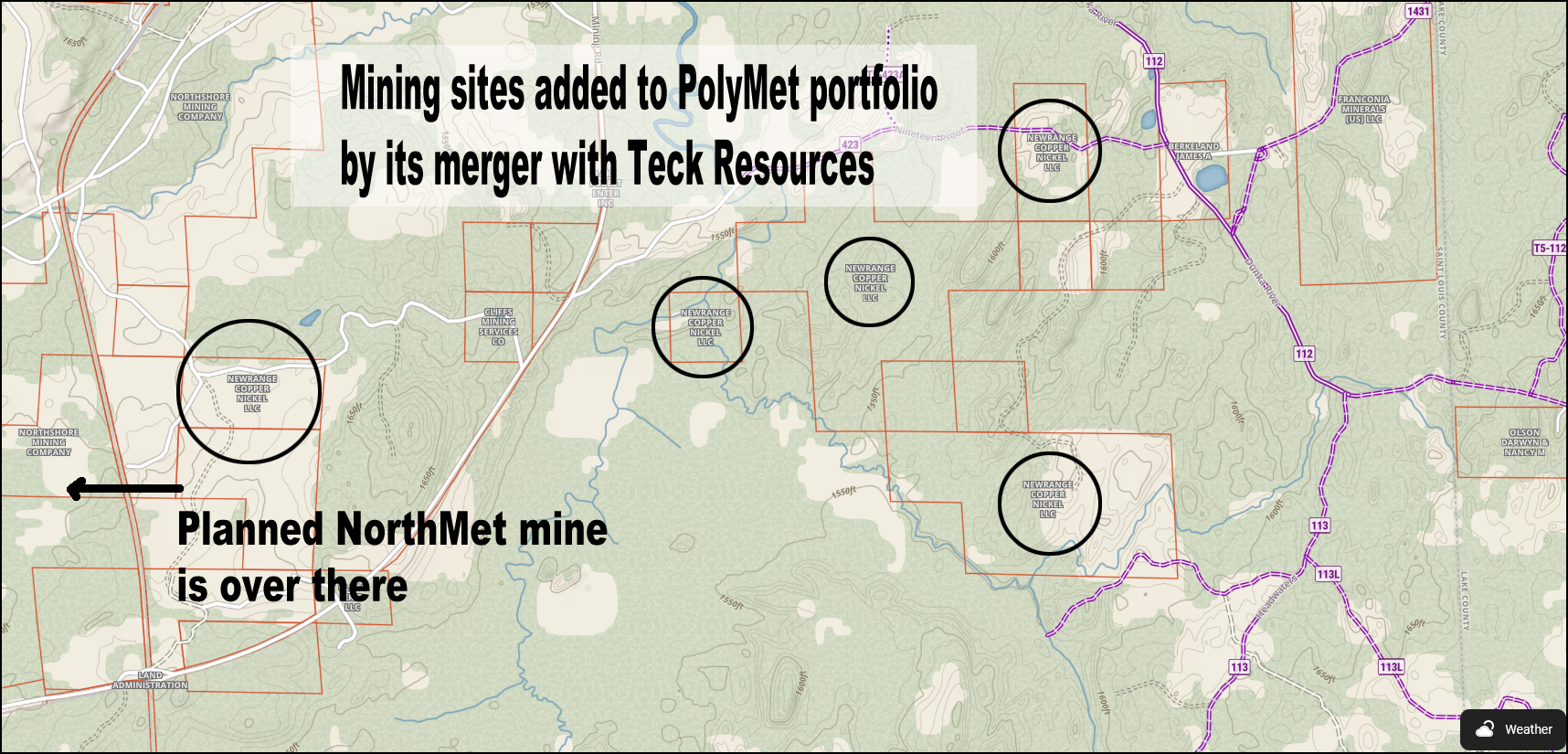
When PolyMet dissolved itself into an equal partnership between Teck Resources of Canada and Glencore of Switzerland it picked up an array of new potential sulfide mine sites
So Grant Wilson has granted an indefinite stay on the ALJ's decision, with very little transparency on just what is happening at NewRange. But reasons for driving a stake in this proposed mine are piling up at this point:
- There is no proposal for how NewRange would meet Minnesota's Reactive Mine Waste law;
- There is no proposal for how NewRange would comply with Minnesota law requiring a term limit for reclamation of the tailings storage facility;
- The engineering firm doing the studies that the stay is based on is no longer working for NewRange;
- The outside counsel that has been working for the DNR, and twisting the law into pretzels, has withdrawn;
- There are new owners and potential operators for the project, and none of the new company's owners, NewRange, Glencore or Teck Resources are on either the Permit to Mine or the application for the Permit.
And that doesn't even take into consideration the wetlands destruction or the water quality permits that have both been set aside. Then there are the things that courts have refused to examine.
For example, the environmental impact statement that greenlit the project never even modeled climate change risks, such as the 500 year flood that happened in nearby Duluth in 2012, or the 200 year rainstorm in 2024 that caused major damage to the tailings basin which required emergency remediation.
And even though the court of appeals ruled that a contested case hearing should have been held on the dangerous overall architecture of the tailings basin (a so-called "upstream" dam), the Minnesota Supreme Court overturned that requirement without even examining the questionable work done by NewRange and the DNR in their assertions that the design is safe.
In this case, the petitioners are not arguing against all copper nickel mining. They are arguing about this PolyMet NorthMet proposed sulfide mine, and that the way its permits were issued doesn't meet existing state and federal law. They've been arguing this same thing for more than a decade, and for all that time the DNR has ignored them.
Now three courts have agreed with the petitioners, and the DNR has hijacked the latest decision by throwing a handful of sand in the legal gears. It's way past time for the agency to take its thumb off the scale and admit what everyone knows: This proposed mine should have been stopped years ago.
-- 30 --
Previous reporting on NorthMet:
Dead Mine Walking, June 2024 | sources
The PolyMet denouement is here, January 11, 2025 | sources